
The Power of Nanotechnology in Muscle Rehabilitation
Muscular rehabilitation is a treatment process used to restore muscle function and strength after a physical injury, or to improve congenital anomalies. Good functional recovery depends on a correct rehabilitation treatment. To apply the correct rehabilitation treatment, real time monitoring of different parameters, such as muscle activity, joint movements, or body temperature, is crucial. For the acquisition of this information, electromyography (EMG) sensors, inertial sensors and temperature sensors are typically used.
In recent decades, high-density electromyography (HD-EMG) has become extremely relevant due to its potential to provide more detailed and accurate data on muscle electrical activity compared to traditional EMG techniques. HD-EMG consists of a high-density electrode matrix, more compact and with better performance, capable of capturing a greater variety of motor units, i.e., a single motor neuron and all the muscle fibres it innervates, throughout the muscle. This allows a detailed analysis of the activation and coordination of motor units, enabling the precise assessment of muscle recruitment patterns and the study of fatigue, motor coordination, and neuromuscular dysfunctions. Among the inertial sensors, accelerometers and gyroscopes are most commonly used in human motion analysis, such as gait analysis. Regarding the temperature sensors, body temperature monitoring assesses the effectiveness of the treatment and potentially detects muscle inflammation. Among the different temperature sensors, resistance temperature detector (RTD) sensors are passive devices whose resistance changes as their temperature changes. They show fast response, high accuracy and excellent linearity.
All these sensors can be manufactured by different techniques, such as cleanroom (CR) and printing techniques, and structures with micro and nanometric resolution can be obtained. In the printing techniques, a conductive ink, typically a silver-based ink, which has micro and/or nanoparticles, is printed on a substrate. These techniques are cheaper than the CR ones, and among them, inkjet-printing, screen-printing or syringe-dispensing can be mentioned.
Despite the potential of these solutions, there are several challenges in using these devices, such as their weight, cost, size, noise, variability in contact between the sensors and skin, and the lack of flexibility and body adaptation of currently available solutions.
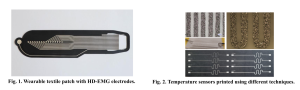
In this context, within the scope of the Agenda “Health from Portugal – HfPT” [C630926586-00465198], co-financed by the Recovery and Resilience Plan (RRP) and by the European funds NextGeneration EU (https://recuperarportugal.gov.pt/), through the Incentive System “Agendas for Business Innovation”, our consortium is working on the manufacturing of HD-EMG (Figure 1) and RTD temperature sensors (Figure 2) in a flexible, lightweight textile structure, by low-cost printing techniques, such as screen-printing and syringe-dispensing, respectively.
This way, the device ensures optimal comfort and skin contact, eliminating the need for bulky electronics or cables. A mobile application provides real-time data to users and healthcare professionals, improving the convenience and effectiveness of rehabilitation programs. Additionally, the project explores the use of biodegradable substrates and biocompatible adhesives to enhance both device performance and sustainability.
You can find more information about the Agenda “Health from Portugal” in the following link: Início | Health from Portugal.

Dr. Aritz Retolaza
PhD em Polymer Science
Research Engineer no International Iberian Nanotechnology Laboratory

